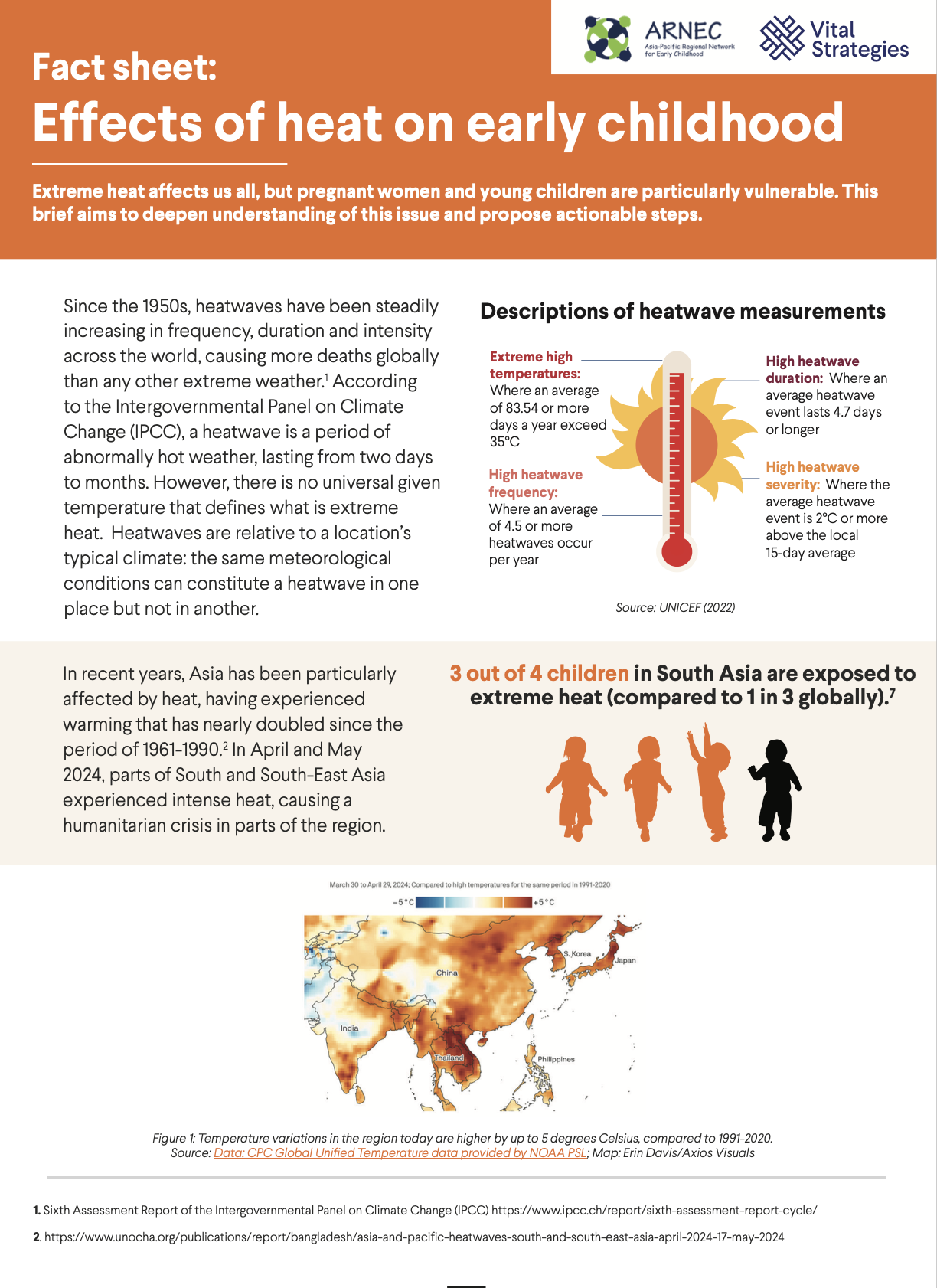
Since the 1950s, heatwaves have been steadily increasing in frequency, duration and intensity across the world, causing more deaths globally than any other extreme weather. While extreme heat affects us all, pregnant women and young children are particularly vulnerable. Young children, particularly infants, are less able to regulate their body temperatures compared to adults. Their smaller bodies absorb more heat from the environment, and they have less capacity to release heat via sweating.
Other health outcomes that have been linked to warmer temperatures include heat stroke and heat stress, increased rates of asthma, increased risk of vector-borne diseases including dengue, increased risk of chronic respiratory conditions, allergy development, low birth weight, undernutrition and diarrhoea. Heatwaves also lead to significant indirect impacts on young children including learning loss, and reduced food and water security. Air pollution exposure also tends to rise with heat, as the risk of wildfires increases and harmful pollutants are more likely to stay in the air during elevated temperatures.
Vital Strategies has partnered with the Asia-Pacific Regional Network for Early Childhood Development (ARNEC) to publish this fact sheet to highlight the specific risks that heat poses to young children and pregnant women, and a list of actions that we can all take to reduce this risk.
This publication is the fourth and final in a series to highlight leading climate and environmental threats on early childhood development in the Asia-Pacific region. To learn more, please email climate@arnec.net
Download the heatwaves fact sheet
Download the lead poisoning fact sheet
Recent Abstracts
Birth and Death Registration as the Anchor for Digital Public Infrastructure and Access to…
Analysing India’s Unique Subnational WHO FCTC Article 5.3 Policies and Their Implementation Across 17…
Strengthening the Tobacco Cessation Ecosystem
Activity Report 2025 – Brazil
More Data Better Health – Brazilian People’s Perceptions of Risk Factors for Cancer
Relatório de Atividades 2025 – Brasil
Mais Dados Mais Saúde – Percepções da população brasileira sobre fatores de risco…
What Primary Care Records Reveal About Cancer Signs and Symptoms
O que os prontuários da atenção primária revelam sobre sinais e sintomas de…
CRVS Performance Measurement and Monitoring Resource Kit