Policy Brief: Download in English / Unduh dalam Bahasa Indonesia
Technical Summary: Download in English / Unduh dalam Bahasa Indonesia
In Jakarta, air pollution is one of the leading environmental health risks, contributing to preventable illness and significant economic losses. While the city has invested in ambient air quality monitoring, measurements from fixed sites cannot fully capture what any individual child breathes throughout their day.
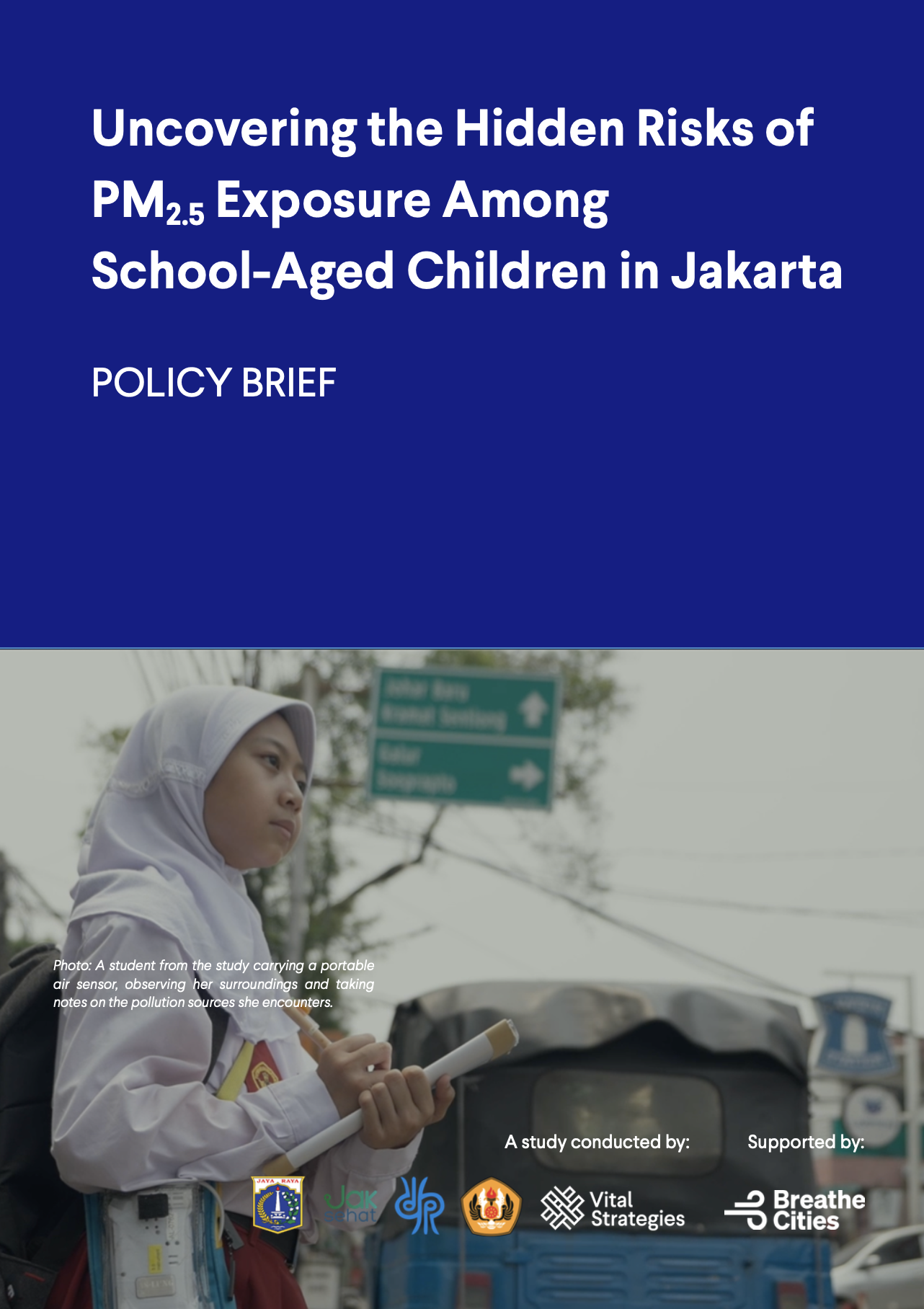
To bridge this gap between population-level data and personal exposure, Vital Strategies — together with Universitas Padjadjaran, the DKI Jakarta Provincial Health Agency, and the DKI Jakarta Provincial Education Agency, with support from Breathe Cities — conducted a personal exposure monitoring study measuring the air quality experienced by children in their daily environments. Using a citizen science approach, fifty-one children across two public primary schools in South and Central Jakarta carried portable air pollution sensors which measured PM2.5 (fine particulate matter – the best single indicator of health damaging air pollution) for 24 hours while keeping a time-activity diary, allowing researchers to link exposure levels directly to location, activity, and pollution source.
Key findings from the study include:
- About 4 in 5 children were exposed to PM2.5 exceeding the national standard over the 24-hour monitoring period.
- There is no safe time of day. Children inhale dangerous levels of PM2.5 throughout the day.
- Home is where most exposure happens. Children spend around 70% of their time at home, making it the dominant exposure environment and potential target for intervention.
- Multiple leading sources of pollution were identified, including traffic, smoking, cooking and waste burning.
This study provides the first personal exposure monitoring data for school-age children in Jakarta. The findings reveal that children were exposed to air pollution across all environments they encountered, highlighting the need for policies and interventions to implement effective protective measures that complement the city’s air pollution reduction policies.
Recent Abstracts
Catalyzing Support for CRVS Improvement – Examples from the Data for Health Initiative
A Guide to Designing Contextualized Civil Registration and Vital Statistics E-Learning Courses
Guide to Developing Standard Operating Procedures (SOPs) for Civil Registration Using a Case-Based…
Building Safe and Healthy Communities
Foundations & Futures: Reimagining Public Health in the Artificial Intelligence Era
Strengthening Health Systems to Address Air Pollution in Ethiopia
Policy Brief: Childhood Blood Lead Surveillance in Indonesia – Findings and Policy Recommendations
Impact of Blue Lanes on Road Safety: Crashes, Speed and Motorcyclists’ Perceptions in…
Impacto da Faixa Azul na Segurança Viária: Sinistros, velocidade e percepções de motociclistas…
Culture is Medicine- a Model of Indigenous Harm Reduction in Practice