

Artificial intelligence (AI) is reshaping what public health systems can see, understand and do. Around the world, governments are exploring how AI can detect risks earlier, allocate resources more effectively and extend the reach of care. But as our latest report makes clear, the question is not how quickly AI can be deployed but whether underlying health systems are strong enough to sustain it responsibly.
Our Foundations & Futures report
Version 2.0 of Foundations & Futures: Reimagining Public Health in the Artificial Intelligence Era reinforces a central finding: AI readiness is system readiness. Drawing on interviews with government leaders and experts, a landscape scan of nearly 200 AI-related public health use cases and a readiness scan covering 63 countries, the report reveals a consistent pattern.
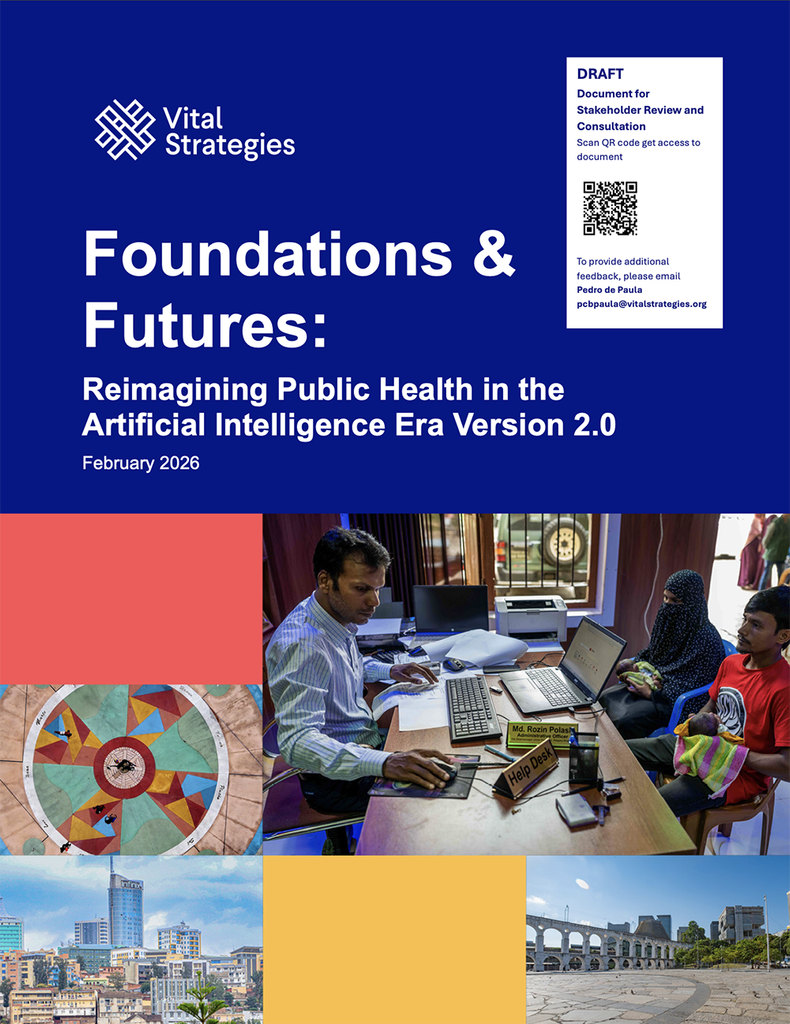
Where core public health data and digital connectivity foundations are weak, AI remains stuck in disconnected pilots. But where those foundations are strong, AI can be integrated responsibly and at scale.
This framed our side event at the India AI Impact Summit 2026 in New Delhi, co-hosted with the World Health Organization South-East Asia Regional Office.
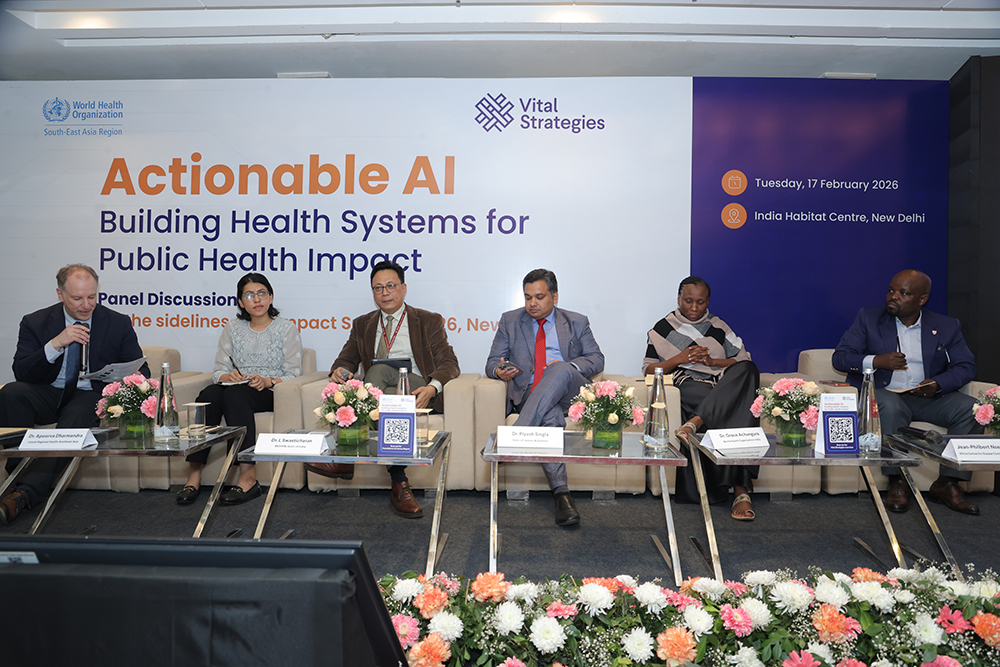
Opening the session, Mary-Ann Etiebet, M.D., President and CEO of Vital Strategies, emphasized that AI presents a profound opportunity for public health.
“For the billions of people living in the Global South, AI has the opportunity to reshape public health systems and improve health outcomes for all. New applications that link data across sectors and sources are demonstrating how AI is driving faster detection, smarter planning and new ways of engaging with the public.”
She also highlighted the launch of the updated report and congratulated the Government of India on the release of its National AI Strategy for Health. India scored remarkably high on foundational readiness. Yet the central takeaway was clear: AI is moving faster than the systems meant to support it. The task now is to mobilize around the strategies required to operationalize AI for real public health impact.
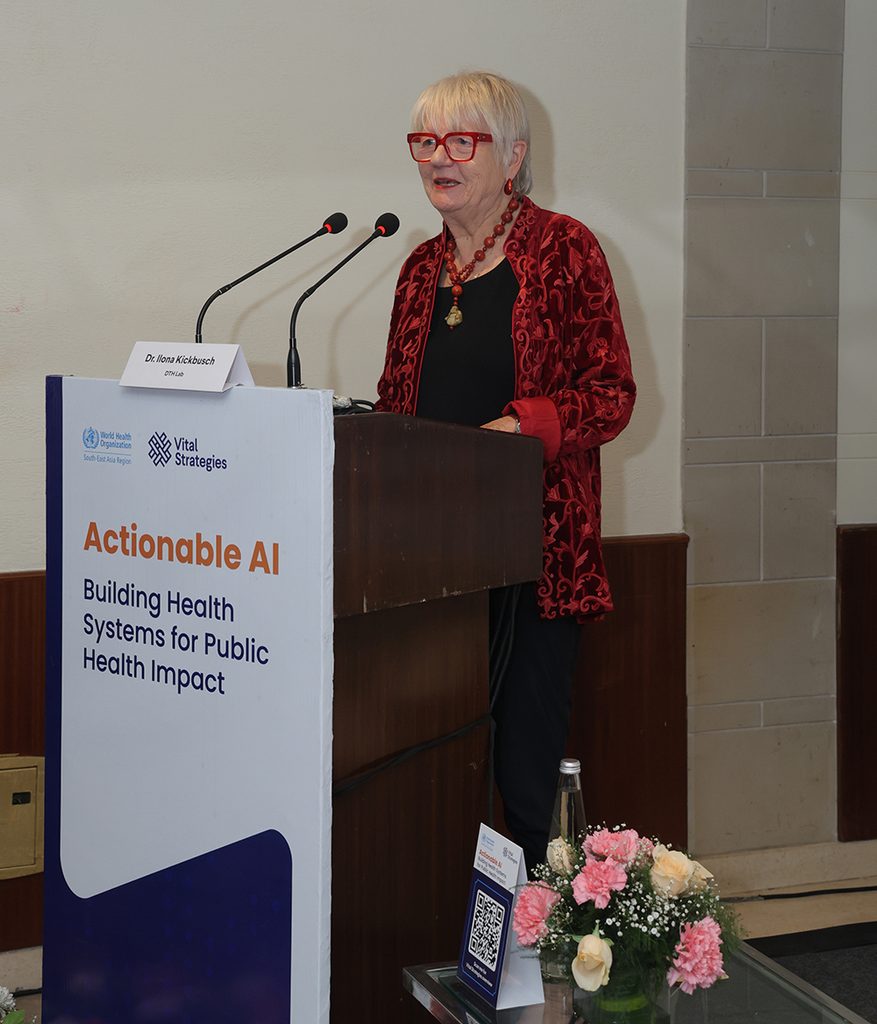
Dr. Ilona Kickbusch, Co-Chair, World Health Summit Council and Director, Digital Transformations for Health Lab reinforced the structural shift underway.
“Artificial intelligence is no longer peripheral to public health—it is now part of its core infrastructure,” Kickbusch said. “History shows us that technological revolutions in health succeed when they are embedded in strong public institutions, and our task is to ensure that the AI revolution follows the same path.”
Dr. Leimapokpam Swasticharan, DDG, Directorate General of Health Services, Ministry of Health and Family Welfare, Government of India, summed up the stakes: “If we introduce AI without structured and standardized data, we risk automating chaos.” He reiterated that without structured data systems, AI can amplify fragmentation rather than resolve it.
The report identifies five dimensions that shape meaningful adoption:
- Governance and institutional ownership
- Data and digital systems
- Connectivity and access
- Human and institutional capacity
- Sustainable financing
Dr. Grace Achungura, Team Leader for Health Systems at WHO India, emphasized what enables progress beyond pilots: “Strong foundations are what allow countries to move from pilots to population-level impact.”
To clarify what readiness truly requires, Version 2.0 introduces a structured AI Use-Case Prerequisites Matrix, distinguishing between minimum conditions to initiate safely and the scale-critical foundations required for sustained integration. The message is consistent throughout: AI cannot compensate for weak systems. It can only build on digitized workflows, interoperable registries and accountable governance structures.
Watch our event: Actionable AI Building Health Systems for Public Health Impact
Read Foundations & Futures: Reimagining Public Health in the Artificial Intelligence Era to explore the full analysis.
Also at the India AI Impact Summit 2026
Launch of the Strategy for Artificial Intelligence for Health in India (SAHI) roadmap
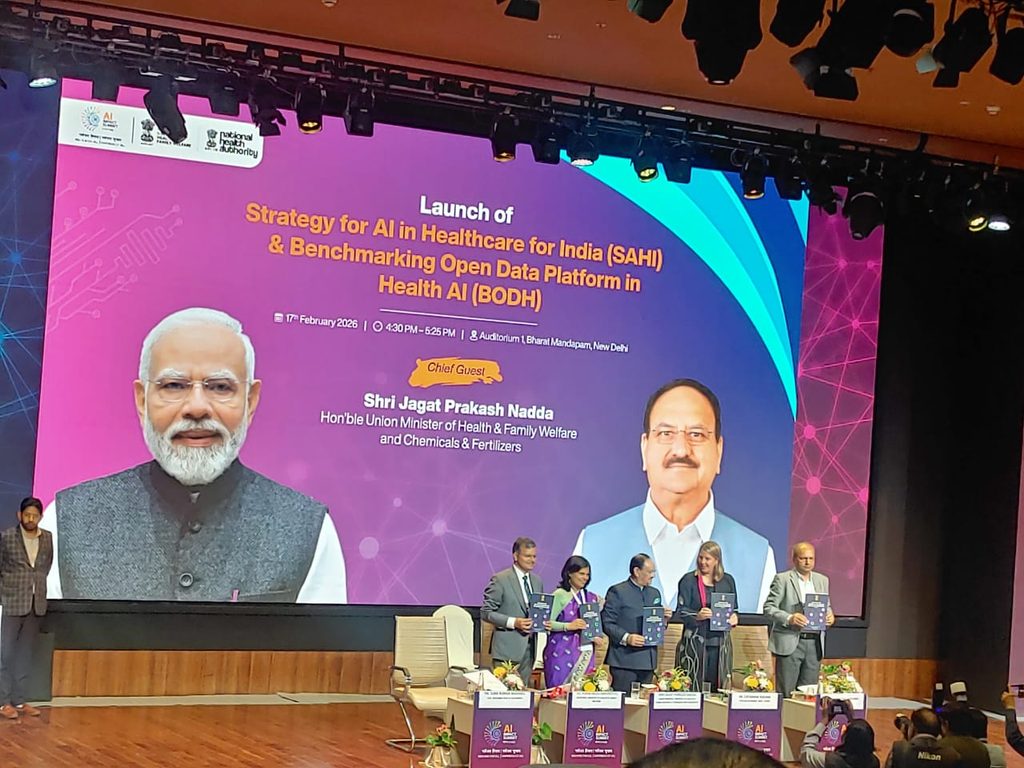
We joined partners at the summit for the formal launch of the Strategy for Artificial Intelligence for Health in India (SAHI) a national roadmap aimed at enabling responsible, scalable and equitable adoption of AI across India’s health systems.
SAHI was developed through a rigorous consultative process involving government, industry, academia, and civil society and provides a focused platform to enable a coordinated national approach for operationalization. Congratulations to the Government of India for this important milestone in integrating digital innovation into India’s public health systems.
Casebook on AI Health Use Cases Across the Global South
We joined World Health Organization South-East Asia and partners at the India AI Impact Summit for the launch of the Casebook on Real-World Impact of AI in Health.
Vital Strategies’ Brazil team contributed a chapter on using open-source AI to convert unstructured clinical notes into structured, actionable data within Brazil’s public health system, improving surveillance and detection of underreported issues such as gender-based violence.
The pilot processed nearly 39 million clinical notes, illustrating how resource-efficient AI can unlock critical public health insights at scale.