
- The first nationally representative survey examining what Brazilians know, think, and do regarding cancer prevention interviewed 6,500 adults across the country.
- While smoking is widely recognized as a risk factor for cancer, other important factors, such as the consumption of ultra-processed products and cured meats, physical inactivity, overweight, and obesity, are less commonly associated with the disease by the population.
- The findings are part of the report More Data Better Health: Perceptions of the Brazilian Population on Cancer Risk Factors (in Portuguese ‘Mais Dados Mais Saúde: Percepções da população brasileira sobre fatores de risco para o câncer) developed by Umane and Vital Strategies, with support from Instituto Devive, and in technical partnership with the Brazilian National Cancer Institute (INCA).
São Paulo, June 2026 — Brazil is expected to record 781,000 new cancer cases per year between 2026 and 2028, according to estimates from the Brazilian National Cancer Institute (INCA). Despite this, 27% of Brazilian adults are unaware that the disease can be prevented. This finding is part of the report More Data Better Health: Perceptions of the Brazilian Population on Cancer Risk Factors, developed by Umane and Vital Strategies, with support from Instituto Devive, and in technical partnership with INCA. This is the first nationally representative survey examining what Brazilians know, think, and do regarding cancer prevention.
Cancer results from the complex interaction of multiple factors, and scientific evidence suggests that up to 40% of cancer cases could be prevented through changes in behavior and environmental exposures. “In this scenario, the importance of understanding the gaps between what people know and how they act regarding cancer risk factors is clear. The belief held by a portion of the population that cancer is inevitable may represent a silent barrier to the adoption of protective behaviors. Understanding these gaps can help guide awareness-raising efforts, encourage self-care, and improve people’s navigation of the healthcare system, all of which are crucial to advancing a prevention agenda supported by cross-sector public policies,” reinforces Evelyn Santos, Investment and Social Impact Manager at Umane. She reminds that “knowledge alone is not enough, we must look at the environments in which people live and make choices that affect their health every day, to integrate action ranging from the regulation and taxation of unhealthy foods to strengthening health systems, social and educational protection, with the goal of improving the population’s well-being and quality of life.”
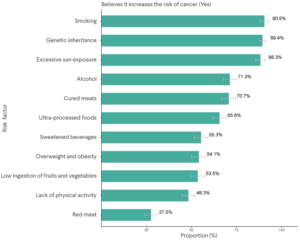
The survey interviewed 6,566 adults aged 18 years and older across all Brazilian states between September and October 2025. The findings showed that the most widely recognized risk factor was smoking, with 90.5% of respondents sharing knowledge that smoking causes cancer, followed by genetic predisposition (89.4%) and excessive sun exposure (88.3%).
Alcoholic beverages, cured meats such as ham, sausages, and smoked turkey breast, and ultra-processed food products such as instant noodles, snack foods, and ice cream are recognized as cancer risk factors by 71.3%, 70.7%, and 65.6% of respondents, respectively.
Although these are not among the most widely recognized risk factors, awareness of their risks is greater than other exposures that are also associated with an increased risk of developing various types of cancer and are not viewed with concern by approximately half of the population. This is the case for excess body weight (overweight and obesity), which is recognized as a cancer risk factor by 54.1% of the Brazilian population. The consumption of sugar-sweetened beverages, such as soft drinks, low intake of fruits and vegetables, and physical inactivity are also less widely recognized and associated with cancer by only 53.3% and 48.3% of respondents, respectively. Meanwhile, red meat is recognized as a factor that increases the risk of developing cancer by fewer than three out of ten Brazilians (27.5%).
“The information shows that risk factors that have received extensive media coverage and have been the focus of public awareness campaigns, such as tobacco use and sun exposure, are widely recognized by the population. In contrast, other factors that are equally relevant from an epidemiological perspective require greater public awareness as preventable cancer risk factors. Another notable finding is the high proportion of Brazilians who recognize genetic inheritance as a risk factor. If not properly contextualized, this perception may reinforce the fatalistic perception of cancer as a predetermined and inevitable condition,” said Luciana Sardinha, Deputy Director of Non-Communicable Diseases at Vital Strategies.
The survey also revealed misconceptions among Brazilians: 61.3% believe that taking vitamin and mineral supplements reduces the risk of cancer. According to the Nutrition, Physical Activity and Cancer Division of the Brazilian National Cancer Institute (INCA), there is no evidence that vitamin and mineral supplements prevent the disease. The recommendation is to obtain protective nutrients through a healthy and varied diet rich in unprocessed and minimally processed foods, rather than through industrially manufactured products. INCA also emphasizes that supplements should only be recommended by healthcare professionals and in specific clinical situations involving insufficiency or deficiency, in order to avoid unnecessary expenses and a false sense of protection encouraged by marketing from the dietary supplement industry.
Another factor that deserves attention is breastfeeding. Despite its benefits for both infants and those who breastfeed, four out of ten respondents do not recognize it as a protective factor against breast cancer.
“One of the study’s key strengths was its ability to provide a more in-depth analysis of public perceptions regarding cancer risk factors, a strategic priority for INCA. The Institute’s technical contribution brought to the survey its extensive experience in producing and interpreting scientific evidence related to cancer prevention and control, enabling a more nuanced interpretation of the findings and their implications for public health in Brazil,” said Luciana Grucci Maya Moreira, Head of the Technical Division for Food, Nutrition, Physical Activity, and Cancer at INCA.
Dietary behavior
In addition to assessing knowledge of cancer risk factors, the survey also examined population behaviors related to the consumption of cured meats, ultra-processed products, red meat, and sweetened beverages. Respondents were asked whether they consumed these products and whether they had attempted to reduce their consumption.
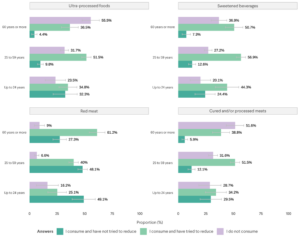
Approximately 45% of respondents reported consuming ultra-processed products and having tried to reduce their consumption, a proportion higher than those who do not consume these products (33%) and among those who reported consuming them without attempting to reduce their intake (approximately 15%). A similar pattern was observed for sweetened beverages: approximately 53% reported consumption with the attempt to reduce intake, 27% reported not consuming these beverages, and about 15% reported consuming them without attempting to reduce their intake.
When it comes to cured meats, the results were very similar to those observed for ultra-processed products: about 45% of respondents reported consuming these foods and attempting to reduce their intake, approximately 33% reported not consuming them, and about 15% mentioned consuming them without attempting to reduce their consumption.
For red meat, the largest proportion of respondents reported consuming it without having attempted to reduce (about 45%), followed by those who reported consuming it and trying to reduce (approximately 40%), and non-consumption was less common (around 10%).
“This pattern is consistent with the lower levels of recognition of red meat as a cancer risk factor. These findings suggest a gap in risk perception among the population, which deserves particular attention in the Brazilian context, given that the country is among the world’s largest cattle producers,” reinforces Luciana Sardinha of Vital Strategies.
Young adults up to 24 years of age are the group with the highest proportion of individuals who consume these products without intending to reduce: 32.3% report this behavior with regard to ultra-processed products, 24.4% for sweetened beverages, 29.5% for cured meats, and an alarming 49.1% for red meat.
On the other hand, 86.3% of the population report consuming fruits and vegetables. Among those who do not consume these foods, 8.3% indicate that they intend to start. The behavior of younger people also stands out in this context: about 80% report consuming fruits and vegetables, and are the age group with the highest proportion of respondents who intend to increase their consumption (16.5%). It is important to note that the survey did not assess whether the population consumed the recommended amounts of fruits and vegetables, and was limited to whether respondents reported consuming these foods.
Sedentary behavior
Regarding sedentary behavior (lack of physical activity), 52.2% of respondents report engaging in physical activity. Among those who do not, 39% indicate that they intend to start. Differences were also observed according to monthly income, where individuals with a monthly income of up to BRL 2,000 showed a lower level of awareness of physical inactivity as a cancer risk factor (45.5%) compared with those earning BRL 10,000 or more per month (59.6%).
Excess body weight
When it comes to body weight, 48.8% of respondents describe their weight as healthy. Among those who recognize that they have excess weight, 31% report taking steps to address it, however, this proportion drops to 22.9% among individuals with a monthly income below BRL 2,000, compared with more than 40% among those earning over BRL 3,000.
These findings provide an important warning about how sociodemographic conditions, such as income, can unequally impact people’s behaviors and intentions to adopt healthier habits. “Physical inactivity is not simply a matter of individual choice: a lack of safe public spaces, long working hours, and unequal access to recreational areas are all part of the problem. The same is true for unequal access to healthy foods. Therefore, public policies that make healthy choices easier are essential, including taxes on products that harm health, such as ultra-processed products and alcohol, while making healthy foods more affordable and ensuring the availability of safe and accessible spaces for physical activity,” said Luciana Sardinha.
Alcoholic beverages
When it comes to alcohol consumption, a risk factor associated with at least eight types of cancer, awareness is considerably lower than for tobacco use, with 71.3% of Brazilians recognizing alcohol as a cancer risk factor. In terms of behavior, half of the population (50.1%) report not consuming alcoholic beverages and, among those who do consume alcohol, 32.5% report having tried to reduce their consumption. Young adults up to 24 years of age have lowest intention to reduce their alcohol consumption: 16.9% report drinking alcohol and having no intention of reducing their consumption, compared with 8.7% of those aged 25 to 59 years and 7.1% of those aged 60 years and older.
About More Data Better Health
More Data Better Health: Perceptions of the Brazilian Population on Cancer Risk Factors (in Portuguese ‘Mais Dados Mais Saúde: Percepção da população brasileira sobre fatores de risco para o câncer) is the fourth edition of the health data innovation program conducted by Umane and Vital Strategies, with support from Instituto Devive. Data collection included 6,566 completed questionnaires gathered between September 24 and October 31, 2025, with nationwide coverage across all 26 states and the Federal District, using a fully digital methodology. The data were weighted by sex, age, race/ethnicity, and educational attainment based on the 2022 Brazilian Census (IBGE) and the 2019 National Health Survey (PNS).
About Umane
Umane is an independent, nonpartisan, nonprofit civil society organization that supports public health initiatives with the goal of contributing to a stronger and more effective Unified Health System (SUS) and improving the quality of life of people living in Brazil. In 2025, Umane supported 35 projects carried out collaboratively with 97 partners from across the health sector, civil society, and government. Umane’s work is organized around three programs. The first focuses on Comprehensive Care for Noncommunicable Diseases (NCDs), supporting initiatives related to risk factor control, screening, expanded access to healthcare, and monitoring of risk factors within Primary Health Care. The second focuses on Strengthening Primary Health Care as the coordinator of care within the SUS, supporting initiatives aimed at improving operational performance, team productivity, service integration, and the incorporation of new technologies into the health system. The third, Women’s, Children’s and Adolescents’ Health, funds programs that monitor adverse pregnancy outcomes and the health conditions of children and adolescents in the context of noncommunicable diseases and their risk factors. Follow Umane on social media: LinkedIn and Instagram.
About Vital Strategies
Vital Strategies is a global health organization that believes everyone should be protected by effective and equitable health policies and systems. Our team works with governments and civil society to design and implement evidence-based strategies and policies to address some of the world’s most pressing public health challenges. The result is millions of people living longer and healthier lives around the world.
About Instituto Devive
Devive is a grantmaking philanthropic organization that supports initiatives aimed at preventing noncommunicable diseases (NCDs), strengthening primary health care networks, and expanding access to diagnosis and treatment for those who need it most. We work in partnership with public sector leaders, civil society organizations, researchers, and social entrepreneurs to translate evidence into health policies and practices that help reduce inequalities across Brazil.
About INCA
The Brazilian National Cancer Institute (INCA), an agency of the Ministry of Health, is responsible for developing and coordinating integrated actions for cancer prevention and control in Brazil. The Institute works across the areas of healthcare delivery, education, research, information, prevention, and surveillance, supporting the development of public policies and the production of technical and scientific knowledge to strengthen Brazil’s Unified Health System (SUS). Through its Prevention and Surveillance Coordination (Conprev), INCA develops initiatives aimed at health promotion and cancer prevention, including actions related to nutrition, physical activity, and the reduction of risk factors associated with the disease.