Around the world, 1 in 3 women experience gender-based violence. In Cambodia, data suggests that over 50% of women who have experienced gender-based violence have not reported it to anyone, managing the burden and potential for continued violence on their own. Cambodia’s Ministry of Women’s Affairs and Ministry of Health are committed to changing that by using a data-driven approach.
With guidance from the Bloomberg Philanthropies Data for Health Initiative’s Data to Policy Program, the ministries have collaborated on a plan for the nationwide expansion of One-Stop Service Units for survivors of gender-based violence.
In this Q&A, we hear from two architects of the plan, Ms. Sar Sineth, Director of the Legal Protection Department, Ministry of Women’s Affairs, and Mr. Khem Chanthorn, Deputy Director of Planning and Health Information, Ministry of Health, about why they are expanding One-Stop Service Units and the key role the Data to Policy Program played in the scale-up.
What is a One-Stop Service Unit, and how do these centers support survivors of gender-based violence?
Sar Sineth: Located in provincial hospitals, One-Stop Service Units provide health, social and legal services to people who have experienced gender-based violence. They are designed to serve and protect victims with effective, timely and inclusive care. By providing a myriad of services in a single setting, these units help to eliminate the barriers to receiving care. They are free and confidential. We provide services to anyone in need, regardless of religion, background or other social division.
Tell us a little bit about the history of One-Stop Service Units in Cambodia, and what the plan for expansion looks like.
Khem Chanthorn: There are currently units in seven provinces across Cambodia, including Phnom Penh, Kampong Cham, Tbong Khmum, Preasvihear, Steung Treng, Battambang and Kampong Chhnang. Continuing our close collaboration with the Ministry of Women’s Affairs, we plan to scale up and implement a One-Stop Service Unit in each of the country’s 25 provinces. The health sector is a crucial element not only of this scale-up, but of the successful day-to-day operation of the services.
The units are built to respond to different types of violence, including physical, mental and sexual violence. While we focus on treating communicable diseases such as HIV/AIDS and sexually transmitted diseases, any clinical interventions that a person who has experienced gender-based violence requires are provided. Our guiding mission is to offer protection and empowerment.
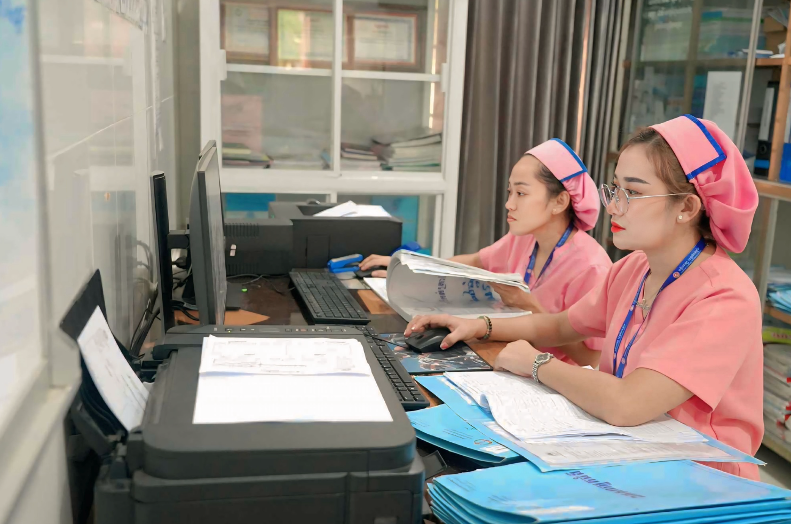
Ministry officials participating in the Bloomberg Philanthropies Data for Health Initiative’s Data to Policy Program produced the policy briefs that outlined the guidelines for expansion. How did Data to Policy help achieve this milestone?
Sar Sineth: Data to Policy helped us to know the situation in Cambodia, as well as the challenges and how to address them so we could offer services that were both effective and timely. We used the program to understand the existing gaps in providing care to people who experience gender-based violence and how to address these gaps. After analyzing the root causes, our team, along with the Ministry of Health, proposed finalizing guidelines on the implementation of One-Stop Service Units as a recommendation to expand their reach.
The program also supported the finalization and dissemination of guidelines to facilitate the implementation of more locations, which should make it easier for provincial governments and facilities to understand the requirements to establish and operate a One-Stop Service Unit.
The Data to Policy program helped us analyze the data we had and use that to actually inform policies, with the confidence that they were data-driven.
The Ministry of Women’s Affairs and Ministry of Health worked closely together on this process. Why was the One-Stop Service Unit expansion a shared priority for both ministries, and what role did that collaboration play in facilitating this rollout?
Sar Sineth: While the Data to Policy program was a major key to our success, the collaboration between our ministry and the Ministry of Health was also essential. The Ministry of Women’s Affairs is a key agency of the government committed to promoting gender equity and empowering women and girls. Because gender equity is a priority for the government as a whole, the participation of leaders from both ministries, like Her Excellency Hou Samith, Secretary of State, Ministry of Women’s Affairs and Her Excellency Pen Ricksy, Secretary of State, Ministry of Health, helped shepherd the process.
Khem Chanthorn: At the Ministry of Health, we’re focused on building the health sector’s capacity to provide quality, scaled-up services to survivors of gender-based violence. By working with the Ministry of Women’s Affairs, we were able to ensure our health system is responsive to gender equity and the full needs of our population. The successful scale-up of these units, and the knowledge that our efforts are informed by data-driven analysis, is a major milestone not only for our collaboration, but also for tackling gender-based violence. We look forward to accomplishing more with our partners to protect the well-being of girls and women of Cambodia.
Special thanks to Her Excellency Hou Samith, Secretary of State, Ministry of Women’s Affairs, Her Excellency Pen Ricksy, Secretary of State, Ministry of Health, and Mr. Sum Vanarath, Deputy Director General of Social Development, Ministry of Women’s Affairs.
About the Bloomberg Philanthropies Data for Health Initiative
Today, approximately half of all deaths in the world go unrecorded; accordingly, health policy decisions are often based on inadequate information. Data for Health, supported by Bloomberg Philanthropies and the Gates Foundation, partners with low- and middle-income countries to improve public health data and use of data for policymaking. To learn more, visit: https://www.bloomberg.org/