
Jakarta, February 2, 2026 — The Directorate of Environmental Health of the Ministry of Health (MoH), together with the Center for Public Health and Nutrition Research of the National Research and Innovation Agency (BRIN) and technical partners Yayasan Pure Earth Indonesia and Vital Strategies, presented the results of the First Phase of Blood Lead Level Surveillance (SKTD) at a national dissemination event bringing together cross-sectoral stakeholders. Although there is no safe level of lead exposure, the SKTD results show that 1 in 7 Indonesian children have elevated blood lead levels that require intervention. The dissemination highlighted the need for a sustainable BLL surveillance system and comprehensive cross-sectoral policies to reduce lead exposure.
Lead exposure has serious impacts on health, particularly for children. High levels of lead exposure can disrupt children’s growth and development, reduce IQ scores, and cause other serious health problems.
Unfortunately, lead exposure often goes undetected due to the absence of clear clinical symptoms. Given its chronic nature and potential for permanent harm, early detection and identification of lead exposure sources are critically important.
The Director of Environmental Health at the Ministry of Health, Dr. Then Suyanti, MD, MM, stated that through the Blood Lead Level Surveillance (SKTD), the government has gained an initial picture of the magnitude of lead exposure among children, as well as the key risk factors that need to be addressed through clinical, environmental, and public policy interventions.
“Data on the prevalence of blood lead levels and potential major sources of lead exposure are essential as a foundation for targeted policymaking. Without data, prevention efforts are difficult to measure and evaluate,” dr. Then explained.
The First Phase of SKTD was conducted from May to November 2025 across six provinces, involving 1,617 children aged 12–59 months. Activities included training of community health cadres and health workers, testing children’s blood lead levels, collecting and analyzing samples of household products and the home environment for lead content; and disseminating results while providing counseling to parents or guardians .The surveillance engaged a wide range of stakeholders at the national, subnational, and community levels.
“Through coordination with various relevant parties, SKTD was implemented using rigorous research methodologies, from study design and sample selection to data collection and analysis. This was done to ensure that the resulting data can serve as a reference for evidence-based policymaking,” said Prof. drh. Ni Luh Putu Indi Darmayanti, Head of the Research Organization for Health, National Research and Innovation Agency (BRIN).
The SKTD results show that 1 in 7 Indonesian children has a blood lead level above 5 micrograms per deciliter (µg/dL), the threshold set by the Ministry of Health for clinical and environmental intervention. Findings also indicate that children living in homes with chipping paint have a 55% higher risk of having blood lead levels ≥5 µg/dL, while parental occupations related to lead, use of metal cookware, and use of cosmetic powder are associated with higher blood lead levels in the children. Conversely, higher parental education and higher income are protective factors associated with lower blood lead levels, reinforcing the need for equity-focused policies to tackle lead exposure in all children.
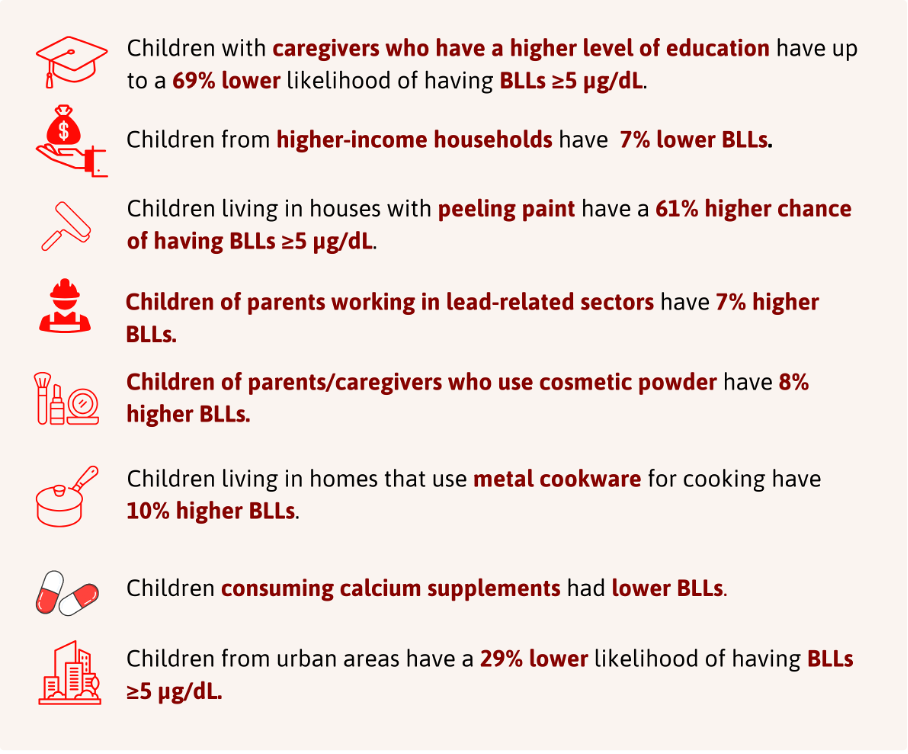
The surveillance also identified sources of lead exposure in the home environment. In products analyses conducted in a subset of 20% of the participating children, more than 20% of samples of metal cookware, ceramic and plastic tableware, cosmetics, children’s and parents’ clothes, and children’s toys contained lead above the threshold. Additionally, every twofold increase in lead concentration in soil, was associated with an average 8% increase in children’s blood lead levels.
“These findings, which inform effective strategies to reduce children’s exposure to lead, will complement Indonesia’s success in being one of the first countries to develop clinical guidelines for lead poisoning consistent with WHO recommendations.” said Edwin Siswono, Epidemiologist at Vital Strategies.
Strengthening the health system through nationwide blood lead level surveillance is one of the key recommendations. Budi Susilorini, Director of Yayasan Pure Earth Indonesia, emphasized the need to record cases, monitor environmental risk factors, and map high-risk areas at a larger scale. “We can draw lessons from the First Phase of SKTD to scale it up nationally. This can be done gradually, starting with strengthening the capacity of health human resources and laboratories for blood lead testing, and integrating children’s blood lead level test results into existing national programs,” Budi added.
In closing, dr. Then underscored that the First Phase of SKTD demonstrates the need for stronger cross-sectoral coordination, particularly among the health, environment, industry, trade, and other relevant sectors, to produce concrete and impactful policies to address lead exposure. “The SKTD results show that preventing lead exposure cannot be undertaken by the health sector alone. Joint cross-sectoral action is required to ensure effective and sustainable control of lead exposure sources. These results are also expected to support the development of the National Action Plan (RAN) for a Lead-Free Indonesia, currently being initiated by the Coordinating Ministry for Human Development and Culture (Kemenko PMK),” she stated.
About the Ministry of Health
The Ministry of Health of the Republic of Indonesia is responsible for formulating and implementing health policies to improve public health outcomes. The Directorate of Environmental Health operates under the Directorate General of Disease Prevention and Control (DG P2P) and is tasked with formulating and implementing policies for disease prevention and control in accordance with prevailing laws and regulations. https://www.kemkes.go.id/
About the National Research and Innovation Agency (BRIN)
Pursuant to Presidential Regulation No. 78 of 2021, the National Research and Innovation Agency (BRIN) is a government institution under and accountable to the President, responsible for conducting integrated research, development, assessment, application, invention, and innovation, as well as nuclear energy and space activities. BRIN has 12 Research Organizations (ROs) as implementing partners for research activities. One of these is the Center for Public Health and Nutrition Research, which was entrusted as the lead researcher for the First Phase SKTD Pilot. https://www.brin.go.id/
About Yayasan Pure Earth (PE Indonesia)
Yayasan Pure Earth Indonesia (PE Indonesia) is an environmental health organization established with a focus on mitigating the impacts of toxic pollution on the environment and human health. PE Indonesia supports the Government of Indonesia through an approach that integrates research, technical interventions, policy recommendations, public education, and capacity building. https://www.pureearth.org/indonesia/
About Vital Strategies
Vital Strategies believes every person should be protected by an equitable and effective public health system. We partner with governments, communities, and organizations around the world to reimagine public health so that health is supported in all the places we live, work, and play. The result is millions of people living longer, healthier lives. Learn more at vitalstrategies.org or follow us on Linkedin.
Contacts for Media:
Narahubung:
Kementerian Kesehatan
Untuk pertanyaan, wawancara, informasi lebih lanjut, hubungi:
Halo Kemenkes melalui hotline 1500-567, kontak@kemkes.go.id, SMS +62 812 8156 2620
BRIN
Untuk pertanyaan, wawancara, informasi lebih lanjut, hubungi:
Basuki Rachmat, ST, MKM, basuki.rachmat@brin.go.id, M: +62 812 9817 9933
Yayasan Pure Earth Indonesia
Untuk pertanyaan, wawancara, informasi lebih lanjut, hubungi:
Lina Noviandari, linanov@pureearth.org, M: +62 812 9698 1485
Vital Strategies
Untuk pertanyaan, wawancara, informasi lebih lanjut, hubungi:
Adellyn D. Ramadhanty, aramadhanty@vitalstrategies.org, M: +62 821 8296 9990